|
THINK-PAIR-SHARE
|
Danielson Compatibility
|
||
|
3b – Questioning and
Discussion
3c – Engaging Students
|
|||
|
What
|
A student centered instructional activity
|
||
|
Why
|
·
Helps students process and analyze
information by sharing ideas with others
·
Encourages critical thinking and writing
prior to large group discussion
·
Engages students in their learning through accountable
talk
|
||
|
When
|
·
Do now to hook and/or to activate prior
knowledge
·
End of the lesson or unit to review ideas or
skills
·
Student activity section of the lesson
·
Start of a new unit or topic as an
introduction
|
||
|
Steps
|
|||
|
Teacher
|
Students
|
||
|
1. Teacher poses topic or question
|
1. Student records topic or question
|
||
|
2. Teacher gives a specific amount of time for students to record their
answers
|
2. Student records his/her answer in allotted time
|
||
|
3. Teacher directs students to make pairs (intentional grouping is
desired)
|
3. Students move into pairs
|
||
|
4. Teacher gives a specific amount of time and specific directions for
students to discuss their individual answers with partners.
|
4. Students compare answers with their partners. They take turns
sharing and recording the discussion.
|
||
|
5. Teacher calls class back together
|
5. Students come to order
|
||
|
6. Teacher facilitates student-centered share-out
|
6. Students participate in and initiate class discussion
|
||
|
Suggestions
|
|||
|
Ø
Use a timer for each step to ensure no time is
wasted and to create urgency
Ø
Provide specific format/structure for note
taking
Ø
Post student pairs on smartboard or chart
paper
Ø
Do LIVE GRADING based on the quality of
discussions
Ø
Assign students a specific task for reporting
back (ex: what is one thing your partner shared)
|
|||

Showing posts with label teaching tips. Show all posts
Showing posts with label teaching tips. Show all posts
Friday, February 21, 2014
Teaching Tip #3: Think-Pair-Share


Sunday, November 22, 2009
Teaching Tip #2
Word Walls!
Though memorizing vocabulary definitions doesn't register too high on the famous Bloom's Taxonomy pyramid, it is often the foundation for understanding and higher order thinking. All students benefit by building their vocabulary in every subject area. Unfortunately, the 10th grade students I inherit every year in the South Bronx have significant vocabulary handicaps, which makes it even more imperative that I push for it in my global history classes. How else will my students debate the pros and cons of capitalism and socialism, or analyze the responses of the Industrial Revolution if they don't know what a union is or who Karl Marx was? Vocabulary is not only foundational, it's also really fun and it's an amazing differentiation tool anyone can use in his/her classroom across all disciplines. The pictures are from my own classroom. Take a look at them as I explain how my word wall works in my classroom and with my students.

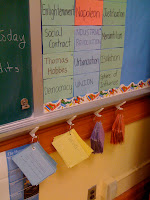
1. I give every student whole punched index cards with a ring to hold them all together (I suggest all students to carry the cards in a ziplock bag so they don't get destroyed).
2. I put up all the words they'll need to memorize at the beginning of each unit. Every unit is a different color so they are easily distinguishable.
3. At the bottom of the word wall I have four identical stacks of vocabulary cards in rings that contain all the terms and definitions that are on the word wall. (These cards are made by various students who earn extra credit points for creating them) The words are written on one side and the definition on the other. Some of these cards have pictures drawn on them to help visualize the meanings.
4. Students are allowed to flip through these note cards whenever they need to check their own definitions. These ringed cards are also great for group study sessions and serve as a great resource. Students never have an excuse for not having their own updated vocabulary cards!
5. Lastly, having a word wall that is visible and attractive allows me to easily access students' prior knowledge and to review terms and concepts we've covered in the past. I point to it almost every single day.
I encourage you to try this in your classrooms. It's a bit of work to get it set up initially, but it's worth it and students feel the immediate gratification of knowing and remembering things they didn't know just the day before. Of course, I give tons of vocabulary quizzes which always includes new and old terms as well as other activities that hold students accountable for retaining all the definitions. Any questions? Fire away.
Though memorizing vocabulary definitions doesn't register too high on the famous Bloom's Taxonomy pyramid, it is often the foundation for understanding and higher order thinking. All students benefit by building their vocabulary in every subject area. Unfortunately, the 10th grade students I inherit every year in the South Bronx have significant vocabulary handicaps, which makes it even more imperative that I push for it in my global history classes. How else will my students debate the pros and cons of capitalism and socialism, or analyze the responses of the Industrial Revolution if they don't know what a union is or who Karl Marx was? Vocabulary is not only foundational, it's also really fun and it's an amazing differentiation tool anyone can use in his/her classroom across all disciplines. The pictures are from my own classroom. Take a look at them as I explain how my word wall works in my classroom and with my students.


1. I give every student whole punched index cards with a ring to hold them all together (I suggest all students to carry the cards in a ziplock bag so they don't get destroyed).
2. I put up all the words they'll need to memorize at the beginning of each unit. Every unit is a different color so they are easily distinguishable.
3. At the bottom of the word wall I have four identical stacks of vocabulary cards in rings that contain all the terms and definitions that are on the word wall. (These cards are made by various students who earn extra credit points for creating them) The words are written on one side and the definition on the other. Some of these cards have pictures drawn on them to help visualize the meanings.
4. Students are allowed to flip through these note cards whenever they need to check their own definitions. These ringed cards are also great for group study sessions and serve as a great resource. Students never have an excuse for not having their own updated vocabulary cards!
5. Lastly, having a word wall that is visible and attractive allows me to easily access students' prior knowledge and to review terms and concepts we've covered in the past. I point to it almost every single day.
I encourage you to try this in your classrooms. It's a bit of work to get it set up initially, but it's worth it and students feel the immediate gratification of knowing and remembering things they didn't know just the day before. Of course, I give tons of vocabulary quizzes which always includes new and old terms as well as other activities that hold students accountable for retaining all the definitions. Any questions? Fire away.
Tuesday, September 22, 2009
Teaching Tip #1

My first tip:
After asking a question to the class, walk AWAY from the student who answers it. I have seen teachers going toward the student giving the answer in order to her him/her better. This is a mistake. You want the student to project so the entire class can hear. You never want a classroom discussion to become an A - B conversation because you'll lose everyone else, and that's an open invitation for disengagement and management issues. A classroom discussion should indeed be a whole classroom discussion, so walk away from the ones giving answers to make them project.
Subscribe to:
Posts (Atom)